How to Turn a Children’s Book into an Animated Video: A Guide for Indian Authors and Publishers
Sushila ji taught Hindi in a Delhi government school for 32 years. After she retired, she finally did what she had always dreamed of: she wrote a book of moral stories for her grandchildren. She paid an illustrator, printed 500 copies, and felt proud the day the boxes arrived.
That was two years ago. Today, around 400 copies are still sitting in those boxes under her bed. Meanwhile, her two grandchildren spend their evenings watching cartoons on the phone.
One evening, she said something that stayed with me: “Bacche ab kitaab nahi padhte. Shayad meri kahaniyan kisi kaam ki nahi.” (Children don’t read books anymore. Maybe my stories are of no use.)
Sushila ji is an example, not a real client, but you may know someone just like her. You might even be her.
Here’s the truth: her stories are not the problem. The format is. That is exactly where children’s book animation in India can help. In this guide, I’ll walk you through everything you need to know, in simple words: what options you have, how the process works, what affects the cost, and which mistakes to avoid.
Why Your Children’s Book Needs More Than Paper Today
Let’s be honest about one thing first. Children still love stories. What has changed is where they meet those stories.
Most children today first discover a story on a screen: on YouTube, on a parent’s phone, or on the smart board in their classroom. A printed book is still valuable, but it often needs a “door” that brings children to it. A short animated video can be that door.
Here’s how animation can help your book:
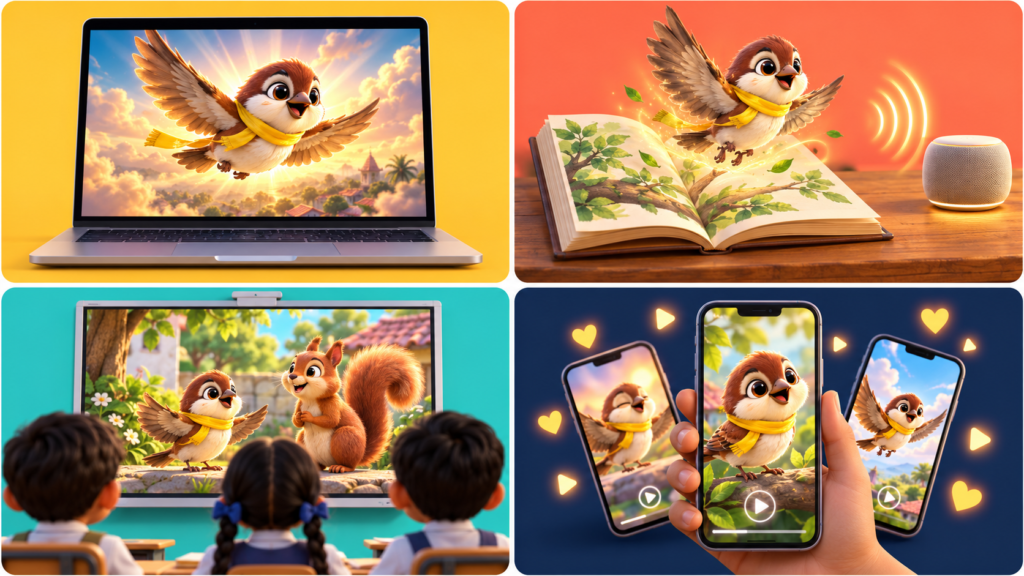
- It reaches children where they already are. A video can be watched on YouTube, shared on Instagram, and forwarded on WhatsApp family groups in minutes.
- It helps teachers use your story. Many schools now use smart classes. An animated moral story is easy for a teacher to play in a value education period.
- It promotes your printed book. A short video can show the characters and the feeling of the story, and make parents curious enough to buy the book.
- It can open new income. Depending on your rights and agreements, a video could be offered to schools or published on your own YouTube channel.
One honest word: animation is not a magic button for book sales. A video helps your story get noticed, but you still need to share it, promote it and connect with the right audience. Think of animation as a powerful tool, not a guarantee.
4 Ways to Turn Your Storybook into an Animated Video
When people hear “animation”, they often imagine a full cartoon film. But there are different ways to turn a storybook into an animated video, and each one suits a different goal and budget.
1. Animated Book Trailer (30–60 seconds)
Just like a film trailer, an animated book trailer for a children’s book shows a glimpse of the characters, the world and the feeling of the story without giving away the ending.
Best for: authors launching a new book, or promoting a book on Amazon, Instagram and WhatsApp.
2. Read-Aloud Animated Story Video
Here, a narrator reads your story aloud while the book’s illustrations gently move and come alive. Characters blink, leaves fall, camera moves glide across the page.
Best for: authors who already have good illustrations, schools and early readers. A read aloud animated story video stays very close to the original book, which many authors love.
3. Full Animated Episode
This is a complete animated version of your story, with characters moving, talking and acting, plus voice-over, music and sound effects.
Best for: publishers building a YouTube channel, or authors whose story has strong characters and a clear moral.
4. A Series of Short Reels
Your story is broken into small 30–60 second pieces, perfect for Instagram Reels and YouTube Shorts.
Best for: building an audience slowly and keeping parents and children coming back.
2D or 3D Animation for Kids: Which One Suits Your Book?
This is one of the most common questions authors ask me. Here is an honest comparison.
2D Animation
2D animation looks flat and hand-drawn, a lot like the pages of a picture book.
- Look: soft, colourful and close to your illustrations
- Works best for: picture books, moral stories, folk tales and books for younger children
- Big advantage: your existing illustrations can often be used or adapted, which keeps the book’s identity
AI-Assisted 3D Animation
3D animation has depth, lighting and a “movie-like” feel. With today’s AI filmmaking tools, a skilled studio can create 3D-style stories more efficiently than before.
- Look: rich, cinematic and modern
- Works best for: adventure stories, stories with exciting worlds, and content made for YouTube audiences
- Things to know: characters usually need to be designed fresh in 3D, and a good studio must work carefully to keep characters looking the same in every scene
My simple rule: if your illustrations are the heart of your book, start with 2D. If you want a fresh, cinematic world for a YouTube audience, consider 3D. When choosing between 2D or 3D animation for kids, think about your readers’ age, your goal, and your budget, not just what looks “fancy”.
The Step-by-Step Process: From Book Pages to Animated Video
A good studio doesn’t just “start animating”. There is a clear process behind every good children’s video. Here’s how it usually works:
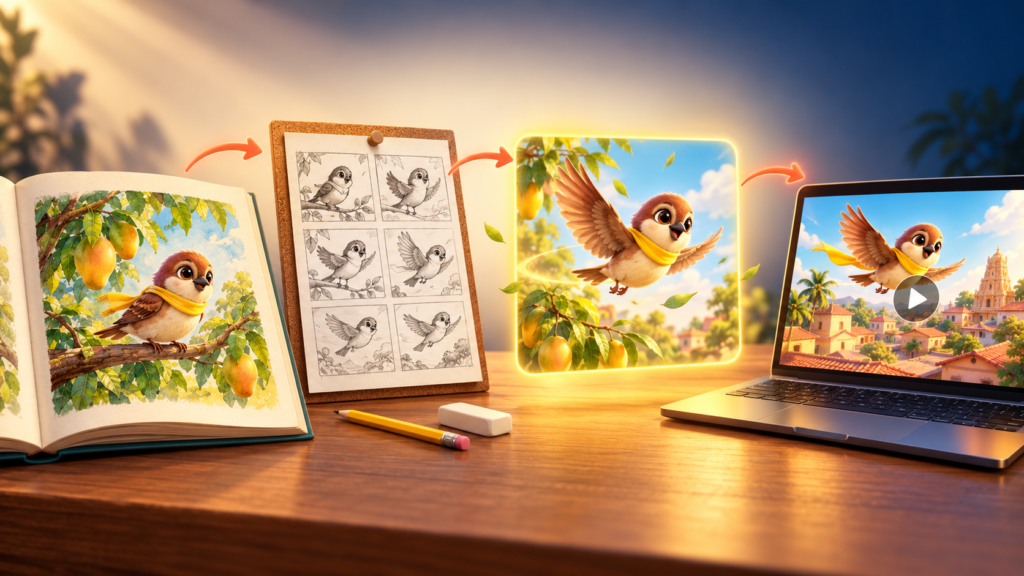
- Story review. The studio reads your book and understands its message, characters and age group.
- Script and screenplay. The book’s text is adapted for video. Some lines are shortened; some actions are added so the story works on screen.
- Shot list. Every scene is broken into shots: close-ups, wide views, camera movements.
- Storyboard. Simple sketches show how each shot will look. This is the best time to give feedback, because changes here are easy.
- Character and background design. Either your book’s illustrations are prepared for animation, or new designs are created that stay true to your story.
- Animation. The characters and scenes come to life.
- Voice-over. A narrator and character voices are recorded in Hindi, English or both.
- Music and sound. Background music and sound effects add emotion and energy.
- Editing. Everything is put together, polished and checked.
- Delivery and publishing. You receive the final video in the right formats for YouTube, Instagram, WhatsApp or school use.
Tip: ask your studio to show you work at the storyboard stage and again before final delivery. It saves time, money and stress.
What You Should Prepare Before Contacting a Studio
You don’t need to be technical. But having these things ready will make the whole journey smoother:
- The final story text. Make sure this is the version you’re happy with.
- Illustration files. High-quality files from your illustrator, ideally the original design files, not just photos of printed pages.
- Written permission from your illustrator. This is very important. Even if you paid for the illustrations, you may not automatically have the right to use them in animation. Check your agreement, and if needed, get written permission.
- Your language choice. Hindi, English, or both? Bilingual videos can reach more families.
- Your target age group. A video for 3-year-olds is very different from one for 10-year-olds.
- Where the video will be published. YouTube, Instagram, schools, or your own website? This affects length and format.
If you are a publisher, also check whether your author contracts cover video adaptation rights. Clear rights today prevent painful problems tomorrow.
What Affects the Cost to Animate a Children’s Book?
Every author wants to know this, and I respect that. The honest answer is that the cost to animate a children’s book depends on several things:
- Length of the video. A 1-minute trailer costs far less than a 10-minute episode.
- 2D or 3D. The style and level of detail change the work involved.
- Existing illustrations or new designs. Using ready illustrations is usually more affordable than designing new characters.
- Voice artists. One narrator costs less than several character voices.
- Number of languages. Each extra language needs fresh voice recording and editing.
- Revisions. More rounds of changes mean more time.
To give you a starting idea, a short animated book trailer usually starts from ₹8,000, and full 2D storybook animation starts from ₹10,000 per minute. AI-assisted 3D animation and extra languages cost more. We always share a clear written quote before starting any work.
A word of caution: be careful of very low prices that sound too good to be true. Cheap work often means copied characters, poor voice quality, or a video you can’t legally use.
What Happened to Sushila ji’s Stories?
Let’s go back to Sushila ji and imagine a better ending.
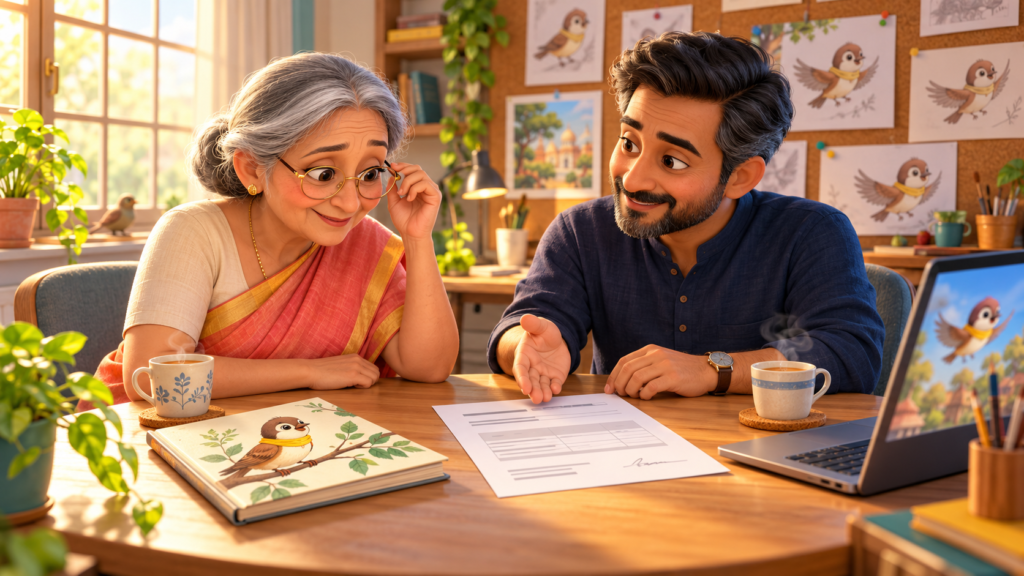
Instead of letting her books gather dust, she chooses one favourite story about a little sparrow who learns honesty. With her illustrator’s written permission, a studio turns it into a 2-minute 2D read-aloud video in Hindi and English.
She shares it in her family WhatsApp groups. Her old school colleagues forward it to teachers they know. A teacher plays it during a value education class. A few parents ask where they can buy the book.
Will this make her a bestselling author overnight? Probably not, and that’s okay. But her story is finally reaching the children it was written for. That is the real win.
Your Story Deserves to Be Seen
If you’re an author or publisher sitting on stories that deserve more children, children’s book animation in India is now more possible and more affordable than ever before. Start small, choose the right format, protect your rights, and work with people who care about your story as much as you do.
At SACCHIN AI FILMS, we create child-safe 2D animations and AI-assisted 3D animated stories that carry moral values in simple Hindi and English. If you’d like an honest opinion on your book, we offer a free story review: we’ll read your story and suggest the format that suits it best, with no pressure.
Email: sacchinaifilmmaking@gmail.com
2D animation work: YouTube @sacchinanimation
AI animated films: YouTube @sacchinaifilms